Tractor Headlights in New Zealand: H4 vs H7, LED Legality and Upgrades
In this guide
- What Tractor Headlights Do
- New Zealand Law on Tractor Headlights
- Types of Tractor Headlight
- H4 vs H7 Tractor Headlight Bulbs
- Are LED Headlight Bulbs Legal in New Zealand
- Approved LED Headlamp Units
- Halogen, LED and Xenon Compared
- Fitment and Compatibility
- How to Upgrade Tractor Headlights to LED
- Common Tractor Headlight Faults
- Tractor Headlight Maintenance
- Frequently asked questions
A tractor headlight is the forward-facing road lamp that gives a dipped and main beam for night driving. Most tractors use halogen H4 or H7 bulbs or sealed LED headlamp units. In New Zealand headlamps are part of the required lighting on a tractor used on the road at night, and headlamps must meet a recognised standard and must not dazzle. A plug-in LED bulb in a halogen headlamp does not meet that test unless it is an approved LED replacement for that bulb type, and none is approved for H4 or H7 at the time of writing.
This guide covers what New Zealand law requires for tractor headlights, the main headlamp types, the difference between H4 and H7 bulbs, whether LED headlight bulbs are legal in New Zealand, approved LED headlamp units, fitment, upgrading, alignment and maintenance.
What Tractor Headlights Do
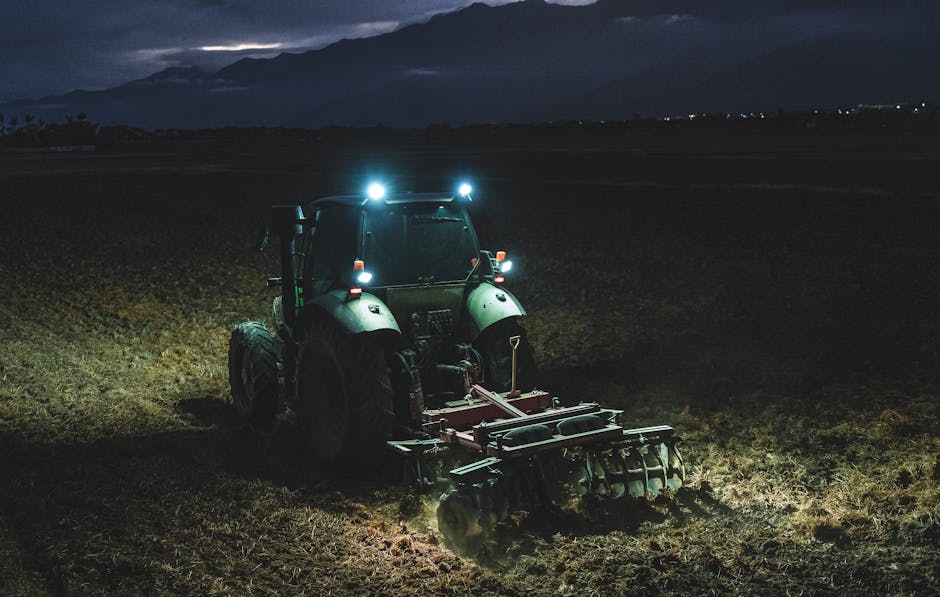
A tractor headlight lights the road ahead with a shaped beam. The dipped beam has a sharp cut-off that keeps light out of oncoming drivers’ eyes, and the main beam throws light further down the road when nothing is coming. Tractor headlights have to do this at up to 60 km/h or so on the fastest tractors, and on narrow unlit local roads where the tractor may be the widest thing for miles.
Tractor headlights are not the same as work lights. Headlights face forward and give a controlled road beam. Work lights mount on the cab roof, rear, or sides and throw a wide flood across the working area. Work lights are for the paddock and the yard; they must be switched off before using the public road, where the headlights do the job.
Many tractors have 2 sets of road headlamps: one in the bonnet or grille, and a second set higher up on the cab or front roof. The upper set is there because a front loader, front linkage implement or front weights can block the bonnet lamps. If something on the front of the tractor hides the lower headlamps, switch to the upper set for road work. Lower front loaders and forks on the road too, as raised forks are a dangerous projection.
New Zealand Law on Tractor Headlights
Vehicle lighting in New Zealand is governed by the Land Transport Rule: Vehicle Lighting 2004, administered by NZ Transport Agency Waka Kotahi (NZTA). Tractors and other agricultural vehicles have their own provisions within the rules. The key points are:
- Who needs them: a tractor or self-propelled agricultural machine used on the road during the hours of darkness needs headlamps as part of its lighting (headlamps, position lamps, rear lamps, stop lamps, indicators and number plate lighting, plus amber warning lamps where required). The exact list for an agricultural vehicle depends on the machine and how it is used, so check NZTA Waka Kotahi’s agricultural vehicle guidance for the exact requirement for your machine.
- When: headlamps must be on during the hours of darkness (half an hour after sunset to half an hour before sunrise) and when visibility is poor. Dipped headlights during the day also help a tractor be seen.
- Colour: headlamps show white light to the front.
- Dazzle: the lighting rule bans lamps that dazzle or confuse other road users.
- Approval: lamps should meet a recognised standard. New Zealand accepts UN ECE (E or e mark) approvals, as well as some other standards such as SAE and the Australian Design Rules, so replace lamps like for like with approved units. European tractors are type-approved under EU Regulation 167/2013, with lighting installation set by Regulation (EU) 2015/208, Annex XII.
Older tractors used only in daylight that do have headlamps fitted should keep them working, and they must not dazzle. For beam aim, follow the angle marked on the tractor or in the handbook. Our guide to headlamp alignment for tractors shows how to set it.
Approval Regulations for Headlamps
Headlamps are approved to UNECE regulations. Halogen and LED headlamps with an asymmetrical dipped beam were approved to R112, xenon headlamps to R98, and symmetrical-beam headlamps to R113. Those regulations have been consolidated into R149, which covers new approvals. A headlamp marked with one of these numbers and an E or e mark, plus the function code (for example HCR for a halogen dipped and main beam), has been tested for road use. Marks from any EU or UNECE country are accepted in New Zealand.
Check the traffic symbol too. New Zealand drives on the left, like the UK. A headlamp made for left-hand traffic carries an arrow in its marking. A headlamp with no arrow is made for right-hand traffic, such as a lamp from a continental-spec tractor, and throws its dipped beam towards oncoming drivers on New Zealand roads.
Types of Tractor Headlight
Tractor headlights fall into 3 main designs: sealed beam units, composite headlamps with a replaceable bulb, and complete LED headlamp units.
Sealed Beam Headlights
A sealed beam headlight is a single unit in which the filament, reflector and lens are permanently bonded together. When the filament fails, the whole unit is replaced. Sealed beams were common on older tractors and still turn up on classic and vintage machines. The common sizes are 5.75 inch round (about 146 mm) and 7 inch round (about 178 mm), plus some rectangular formats.
Many sealed beam sizes are also available as semi-sealed units: a glass lens and reflector that take a replaceable H4 bulb, which is cheaper to run and brighter than an old sealed beam.
Composite Headlights (Replaceable Bulb)
A composite headlight has a reflector and lens housing with a separate bulb that fits from the back. Most tractors from the 1990s onwards use this design, typically with H4 bulbs (dipped and main in one bulb) or H7 bulbs (one bulb per beam). A blown bulb is a quick, cheap replacement rather than a whole new lamp.
LED Headlamp Units
An LED headlamp unit is a complete lamp with LED light sources, optics and lens built in as one sealed assembly. Approved LED headlamp units are made in the common round and rectangular sizes as direct replacements for sealed beam and composite headlamps. Recent tractors increasingly leave the factory with LED headlamps as standard.
H4 vs H7 Tractor Headlight Bulbs
H4 and H7 are the 2 halogen bulbs most tractor headlights use, and they are not interchangeable. An H4 is a twin-filament bulb that gives both dipped and main beam. An H7 is a single-filament bulb that gives one beam, so a headlamp built for H7 uses 1 bulb for dipped beam and a separate bulb or headlamp section for main beam.
| Specification | H4 | H7 |
|---|---|---|
| Filaments | 2 (dipped and main) | 1 |
| Base | P43t | PX26d |
| Terminals | 3 | 2 |
| Standard 12V rating | 60/55W | 55W |
| Standard 24V rating | 75/70W | 70W |
| Typical 12V output (approx) | 1,650 lm main / 1,000 lm dipped | 1,500 lm |
| Typical tractor use | Combined dipped and main headlamps, semi-sealed round units | Separate dipped and main beam reflectors or projector headlamps |
The quickest check is the back of the bulb: 3 flat terminals means H4, 2 terminals means H7. Always match the voltage, because a 12V bulb in a 24V system fails almost straight away. For the full detail on each bulb, read our guides to H4 bulbs and H7 bulbs, or the side-by-side H4 vs H7 comparison.
Higher-Output Halogen Bulbs
If you want more light from a halogen headlamp without changing the lamp, a higher-output halogen H4 or H7 is the legal route. These run at the standard wattage and carry approval as a filament light source, so they keep the headlamp’s approval intact. They often trade some bulb life for the extra output.
Are LED Headlight Bulbs Legal in New Zealand
Ordinary LED replacement bulbs fitted into halogen headlamps are not a safe bet for road use in New Zealand. Retrofit HID or LED bulbs are not always compatible with the vehicle or headlamp, and a headlamp must meet a recognised standard and give a beam that does not dazzle. A halogen headlamp is approved as a lamp designed for a specific filament bulb category, such as H4 or H7. Putting an LED bulb in it changes where the light comes from inside the reflector, and the beam pattern, cut-off and glare are no longer what the headlamp was approved with.
NZTA’s Vehicle Inspection Requirements Manual treats unsuitable headlamp conversions strictly, and a car or truck with HID or LED bulbs retrofitted into ordinary halogen headlamps can fail its WoF or CoF. Factory HID systems normally come with self-levelling and headlamp cleaning, which a retrofit bulb does not add. Complete replacement headlamp units built and approved with LED light sources are a different matter and are covered below.
What That Means for Tractors
Many farm tractors do not need a WoF or CoF in New Zealand, so a farm tractor may never be failed at an inspection for an LED bulb. The road law still applies every time it is on the road. LED bulbs in halogen reflectors commonly scatter light above the cut-off and dazzle oncoming drivers, which the lighting rule does not allow. Tractors that do need a WoF or CoF have their headlamps checked, and lamp faults are failure items.
What About LED Bulbs Sold as “Road Legal”
UNECE has started approving LED substitute light sources (LEDr) for a small number of filament bulb categories under Regulation 37. At the time of writing, no LEDr bulb is approved for H4 or H7. Treat any H4 or H7 LED bulb labelled “road legal” or “E-marked” with suspicion: an E-mark on an LED bulb is often an EMC (Regulation 10) approval, which covers radio interference, not the light.
Approved LED Headlamp Units
The legal way to get LED headlights on a tractor is a complete LED headlamp unit approved as a headlamp. The lamp, the LEDs and the optics are tested together, so the beam pattern and cut-off are part of the approval.
When choosing one, check:
- The approval mark: a circle E (or rectangle e) with a country number and a headlamp approval to R112 or R149 (or R113 for symmetrical beams), with function codes such as HC (dipped), HR (main) or HCR (both).
- The traffic arrow: it must be suitable for left-hand traffic, as driven in New Zealand.
- The size and fixing: 7 inch round, 5.75 inch round and common rectangular sizes are made as drop-in replacements.
- The connector: many LED units use an H4-style 3-pin plug so they connect to the original loom.
- The voltage: many LED units are multi-voltage for 12V and 24V systems.
- EMC: an R10 approval helps avoid interference with radios and GPS guidance.
Browse LED tractor headlights for complete LED units, or halogen tractor headlights for replacement halogen headlamps and semi-sealed units. Orders ship from the UK, and delivery to New Zealand is free on orders over NZ$500. Prices are in NZ dollars, and any NZ GST, duty or Customs fees are paid on delivery.
Halogen, LED and Xenon Compared
Halogen, LED and xenon (HID) are the 3 headlight technologies found on tractors. The table compares them as complete headlamp systems.
| Specification | Halogen | LED headlamp unit | Xenon (HID) |
|---|---|---|---|
| Light source output | About 1,000 lm dipped (H4), 1,500 lm (H7) | Varies by unit; check the maker’s data | About 3,200 lm (D-series burner) |
| Power draw | 55W to 60W per bulb at 12V | Typically well below halogen for similar light | About 35W per burner plus ballast |
| Light colour | Warm white | Cool white | Cool white |
| Warm-up | Instant | Instant | A few seconds to full output |
| Vibration resistance | Low (filament can break) | High (no filament) | Moderate (no filament, ballast is an extra part) |
| Repair | Change the bulb | Replace the whole unit | Change burner or ballast |
Which Technology Suits Tractor Use Best
Approved LED headlamp units give the best combination of output, life and durability for agricultural use. No filament means no failures from rough-ground vibration, which is the main reason halogen bulbs fail early on tractors. The lower current draw also helps on older tractors with small alternators.
Halogen remains the cheapest to buy and the easiest to repair at the roadside, and a higher-output halogen bulb in a good reflector is a sound choice for a tractor that does little night road work. Xenon retrofits were popular for a while, but HID bulbs retrofitted into halogen headlamps can fail a WoF or CoF, and approved LED units have largely taken over.
Fitment and Compatibility
Fitting the right tractor headlight means matching 3 things: housing size, connector and beam pattern.
Housing Size
Measure the existing headlamp across its face. The common sizes are 7 inch round (178 mm) and 5.75 inch round (146 mm), plus rectangular formats that vary by make. Many tractors use headlamps specific to the bonnet or cab design, so check the part number on the back of the old lamp or in the parts book.
Connector
H4 headlamps use a 3-terminal plug (dipped, main and earth). H7 headlamps use a 2-terminal plug per bulb. Some tractors use sealed connectors such as Deutsch or Superseal on the loom side. Photograph the connector before ordering.
Beam Pattern
A road headlamp must produce a dipped beam with a defined cut-off, set for left-hand traffic. An LED lamp with a flood or spot pattern and no cut-off is a work lamp or driving lamp, not a headlamp, whatever its output. On the road, beam control matters more than lumens.
Make-Specific Headlamps
Headlamp shape and fixings vary between makes, series and model years, and even within a series. Always confirm the part against the specific tractor. For John Deere owners, browse our John Deere tractor headlights for make-specific replacements. For fitment advice, call +44 1522 440522 or email [email protected].
How to Upgrade Tractor Headlights to LED
Upgrading to LED means replacing the headlamp, not the bulb. The job takes 30 minutes to 2 hours depending on access and whether an adapter loom is needed.
Step 1: Identify the Current Headlamp
Note the shape, size, whether it is a sealed beam or takes a bulb (and which bulb), and any part number. Check whether the tractor has bonnet headlamps, roof headlamps or both.
Step 2: Check the Connector
Look at the plug on the back of the headlamp. Common types are an H4 3-terminal plug, an H7 2-terminal plug, a sealed beam 3-terminal plug or a sealed connector on a flying lead.
Step 3: Choose an Approved LED Headlamp Unit
Pick a unit that matches the size and connector and carries a headlamp approval (R112 or R149) with a left-hand traffic marking. Do not use an LED bulb in the old halogen headlamp.
Step 4: Isolate the Battery
Disconnect the battery or use the isolator before touching headlamp wiring.
Step 5: Remove the Old Headlamp
Undo the retaining ring or fixing screws, being careful not to disturb the aiming screws if you can avoid it, and unplug the connector.
Step 6: Fit the New Unit
Fit the LED unit into the bracket with the original or supplied fixings. Connect the plug. Where an adapter is needed, use sealed connectors and check polarity: LED units, unlike bulbs, can be polarity-sensitive.
Step 7: Test
Reconnect the battery and check dipped beam, main beam and the main beam tell-tale. If the LED unit flickers, check the earth and the switch or relay feed. Some older tractors with dash bulb-failure warnings may need the LED unit’s recommended adapter.
Step 8: Align the Beam
Set the beam on level ground against a wall so the dipped cut-off sits below the headlamp centre height by the correct amount. A new lamp almost always needs aiming, and a badly aimed lamp can dazzle, which the New Zealand rules do not allow.
Common Tractor Headlight Faults
Most tractor headlight faults come down to a bulb, a feed, or an earth. Work from the simplest check upwards.
- One headlight out: usually the bulb. On an H4, check both filaments, because dipped can fail while main still works. If the bulb is good, check the plug for burnt or corroded terminals and the earth wire.
- Both dipped beams out: a shared fault, such as the dipped beam fuse, the headlamp relay or the dip switch on the column stalk. Check the fuse first.
- Main beam not working: check the main beam fuse and relay, then the switch. A working tell-tale with no main beam points to the feed between the relay and the lamps.
- Dim or yellow lights: voltage drop from a poor earth, corroded connectors or a weak charging system. Measure the voltage at the headlamp plug with the engine running and compare it with the battery.
- Melted H4 connector: caused by a loose or corroded terminal heating up under load. Replace the connector and the bulb, not just the bulb.
- Bulbs blowing repeatedly: often high charging voltage, vibration from a loose mounting, or skin oil on the glass.
Tractor Headlight Maintenance
Regular headlamp maintenance keeps the beam bright and legal. Mud, dust, spray residue and vibration all take their toll.
Clean the lenses regularly. Mud on the lens cuts output dramatically, especially after a day drawing slurry or silage on wet roads. Use a soft cloth and mild soapy water. Avoid abrasive cleaners and scouring pads, which scratch plastic lenses and cause permanent hazing.
Check alignment after heavy work. Headlamps can be knocked out of aim by heavy cultivation work, rough tracks or a front loader. Check at the start of each season.
Inspect connectors for corrosion. Green or white deposits on terminals increase resistance, dim the lamp and generate heat, which can melt an H4 connector. Clean with contact cleaner and use dielectric grease.
Replace rubber boots and seals. The rubber boot behind a composite headlamp keeps water out. A split or missing boot lets condensation form inside the lens, which scatters the beam and tarnishes the reflector.
Handle halogen bulbs by the base. Skin oils on the glass create hot spots that shorten bulb life. If you touch the glass, clean it with isopropyl alcohol before fitting.
Replace both halogen bulbs together. When one bulb fails, the other is usually near the end of its life, and matched bulbs give an even beam.
Frequently asked questions
Are LED headlight bulbs legal in New Zealand?
Only in limited cases. Headlamps must meet a recognised standard and must not dazzle, and an unsuitable LED or HID conversion can fail a WoF or CoF. No LED replacement bulb is approved for H4 or H7 at the time of writing. A complete LED headlamp unit approved as a headlamp is legal.
Is an H4 LED bulb legal on a tractor?
An H4 LED bulb in a halogen headlamp is not an approved combination for road use. Many farm tractors have no periodic inspection in New Zealand, but they must be roadworthy and must not dazzle, and LED bulbs in halogen reflectors often do. Fit an approved LED headlamp unit instead.
Which bulb does a tractor headlight use?
Most tractor headlights with replaceable bulbs use an H4 (twin filament, dipped and main) or an H7 (single filament, one beam). Check the old bulb: 3 terminals means H4, 2 means H7, and match the voltage.
Can I swap H7 bulbs for H4?
No. H4 and H7 bulbs have different bases (P43t and PX26d) and different numbers of filaments, and the headlamp reflector is designed around one or the other.
Why does my tractor have two sets of headlights?
Many tractors have headlamps in the bonnet and a second set on the cab or front roof. The upper set is for road use when a front loader or front-mounted implement blocks the bonnet lamps.